History
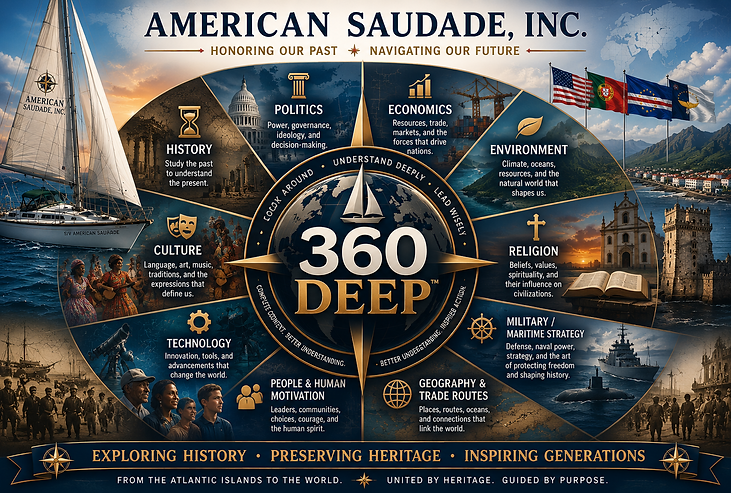
History provides the foundation of the 360-DEEP™ method. No event begins at the moment it enters the historical record. Every conflict, voyage, migration, discovery, political movement, and cultural transformation has roots extending into the past. Going 360-DEEP means examining those roots, identifying patterns, understanding cause and consequence, and recognizing how the memory and interpretation of earlier events continue to influence the present.
Politics
Political decisions shape nations, communities, alliances, conflicts, exploration, migration, and trade. The 360-DEEP™ approach examines who holds power, how that power is acquired and exercised, what interests influence decision-making, and how governments, institutions, laws, alliances, and rivalries affect historical outcomes. Politics is studied not in isolation, but in connection with economics, culture, geography, religion, and human ambition.
Economics
Behind many of history's great events lies an economic reality. Trade, resources, labor, taxation, poverty, wealth, markets, and competition have influenced exploration, empire, migration, war, and technological development. The 360-DEEP™ method asks what economic pressures and opportunities existed, who benefited, who carried the burden, and how the movement of goods, capital, and labor influenced the course of events.
Environment
Human history takes place within the natural world. Climate, weather, oceans, winds, currents, drought, disease, agriculture, and natural resources can influence the rise and decline of societies. Through the 360-DEEP™ lens, the environment is not simply a background setting. It is an active force that can shape human choices, limit possibilities, create opportunities, and sometimes alter the direction of history itself.
Culture
Culture helps explain how people understand themselves and the world around them. Language, music, food, art, family traditions, storytelling, customs, and shared memories all contribute to identity. The 360-DEEP™ philosophy examines how cultures develop, interact, adapt, survive, and change through migration, trade, conflict, colonization, and the movement of people across borders and oceans.
Religion
Religion has shaped civilizations, laws, moral systems, political authority, exploration, conflict, education, art, and community life throughout human history. The 360-DEEP™ approach examines religious belief within its historical and cultural context while also considering its relationship with politics, economics, philosophy, identity, and social change. The objective is understanding: how beliefs develop, how they influence human behavior, and how they interact with the world around them.
Technology
Technology changes what human beings are capable of doing. The compass, printing press, steam engine, telegraph, radio, submarine, aircraft, satellite, computer, and artificial intelligence each transformed the societies that created and adopted them. 360-DEEP™ examines not only how a technology works, but why it emerged, who controlled it, how it changed power relationships, and what intended and unintended consequences followed.
Military / Maritime Strategy
Military and maritime strategy cannot be understood through battles and ships alone. Strategy involves geography, logistics, economics, technology, intelligence, leadership, diplomacy, industrial capacity, and human endurance. The 360-DEEP™ method examines why strategic decisions were made, what alternatives existed, what resources were available, and how sea power, trade routes, naval technology, and maritime geography influenced both conflict and peace.
People & Human Motivation
History is ultimately shaped by people. Leaders, sailors, soldiers, workers, migrants, inventors, families, and ordinary individuals all make decisions based on circumstances, beliefs, ambitions, fears, loyalties, opportunities, and limitations. 360-DEEP™ seeks to understand people within the world they actually inhabited rather than judging them only through the assumptions of the present. Understanding motivation does not require agreement; it requires careful examination of context.
Geography & Trade Routes
Geography shapes possibility. Mountains, rivers, deserts, islands, harbors, ocean currents, prevailing winds, natural resources, and strategic waterways have influenced where civilizations developed and how nations interacted. Trade routes carried far more than goods: they carried people, languages, religions, technologies, ideas, diseases, and cultures. Through the 360-DEEP™ lens, maps are not simply illustrations of history—they are essential tools for understanding why history unfolded where and how it did.

